
How much do immigrants contribute to the economy?

For the United States as a whole, immigrants’ share of total output was 18.0% in 2023 (see Table 1) or $2.1 trillion in 2024 dollars. This means that the contribution of immigrants to economic output is larger than their share of the total population, as immigrants made up 14.3% of the total U.S. population in the same year.

Close

For the United States as a whole, immigrants’ share of total output was 18.0% in 2023 (see Table 1) or $2.1 trillion in 2024 dollars. This means that the contribution of immigrants to economic output is larger than their share of the total population, as immigrants made up 14.3% of the total U.S. population in the same year.

One way to quantify the contribution of immigrants to the U.S. economy is by accounting for the wages and salaries they earn, as well as the income of immigrant-owned businesses, as a share of all wages, salaries, and business income during a given period. For the United States as a whole, immigrants’ share of total output was 18.0% in 2023 (see Table 1) or $2.1 trillion in 2024 dollars. This means that the contribution of immigrants to economic output is larger than their share of the total population, as immigrants made up 14.3% of the total U.S. population in the same year.

Table 1

Immigrants punch above their weight in the U.S. economyReal contribution to economic output compared with population size, by nativity, 2023
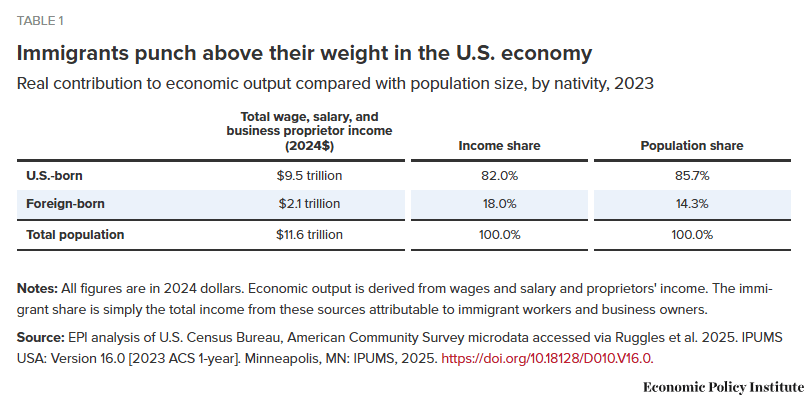
Notes: All figures are in 2024 dollars. Economic output is derived from wages and salary and proprietors’ income. The immigrant share is simply the total income from these sources attributable to immigrant workers and business owners.

Source: EPI analysis of U.S. Census Bureau, American Community Survey microdata accessed via Ruggles et al. 2025. IPUMS USA: Version 16.0 [2023 ACS 1-year]. Minneapolis, MN: IPUMS, 2025. https://doi.org/10.18128/D010.V16.0.

 Share Tweet

 Embed  Download image

Immigrants have an outsized role in U.S. economic output because they are disproportionately likely to be working and are concentrated among prime working ages. Despite accounting for 14.3% of the population, immigrants made up 18.6% of the labor force in 2023.9 Immigrants are also more likely to start businesses. Relative to their share of the population and to native-born peers, immigrants are significantly more likely to start companies of all sizes, including those that generate employment.10 Between 2005 and 2010, by one measure, immigrants had an 80% higher rate of firm founding than their U.S.-born peers.11 Even if many of these business openings ultimately result in closings, the constant churn is important to economic growth. According to another study, immigrants in 2013 accounted for 16% of the U.S. labor force but were 18% of business owners, and 28% of main street businesses, which are defined by the authors as retail, food services and accommodation, and neighborhood services such as nail salons, beauty shops, and gas stations).12


Notes

9. EPI analysis of Bureau of Labor Statistics’ Current Population Survey public data series, Table A-7: Employment Status of the Civilian Population by Nativity and Sex, Not Seasonally Adjusted. Retrieved March 10, 2025.

10. Pierre Azoulay, Benjamin F. Jones, J. Daniel Kim, and Javier Miranda, “Immigration and Entrepreneurship in the United States,” American Economic Review: Insights 4, no. 1 (March 2022): 71–88.

11. Pierre Azoulay, Benjamin F. Jones, J. Daniel Kim, and Javier Miranda, “Immigration and Entrepreneurship in the United States,” American Economic Review: Insights 4, no. 1 (March 2022): 71–88.

12. David Dyssegaard Kallick, Bringing Vitality to Main Street: How Immigrant Small Businesses Help Local Economies Grow, Fiscal Policy Institute and Americas Society/Council of The Americas, January 2015.

Published by Economic Policy Institute

Sports & Youth Development Program

At African Careers, our Sports and Youth Development Program is a powerful community initiative rooted in South Seattle and King County. We are committed to inspiring, mentoring, coaching, and developing underserved youth through the transformative power of sports.

Our program goes beyond athletic training — we foster leadership, teamwork, discipline, and resilience, helping young people unlock their full potential both on and off the field. By creating safe, inclusive spaces for growth and connection, we empower youth to build confidence, set goals, and pursue brighter futures.

Through partnerships with dedicated coaches, mentors, and community leaders, we aim to close opportunity gaps and ensure every young person — regardless of background — has access to positive role models, structured activities, and long-term support.

Together, we are investing in the next generation of leaders, athletes, and changemakers in South Seattle and King County.

Equity in Education: A Commitment to Every Student’s Success

April 5, 2025

By Abdirahman Omar

Education is often hailed as the great equalizer bridge from disadvantage to opportunity. But what happens when that bridge is only accessible to some and not all? When academic pathways are riddled with systemic barriers that disproportionately impact historically marginalized communities, we must confront an uncomfortable truth: equality is not the same as equity.

At its core, equity in education means recognizing and responding to the unique circumstances of each student. It is not about treating all students the same, it is about meeting students where they are and supporting them with what they need to succeed.

This is not a lofty ideal. It is necessary course correction in a system that has failed too often:

  • Students of color
  • English language learners
  • Students with disabilities
  • Youth from low-income households

📚 Reports by The Education Trust and the Learning Policy Institute have consistently documented how systemic inequality deprives these groups of access to rigorous curricula, experienced educators, and emotionally safe learning environments.

Equality ≠ Equity

Equality offers everyone the same resources. Equity offers each learner the resources and opportunities they specifically need to thrive.

That might mean:

  • Language support programs for English language learners
  • Trauma-informed practices for students impacted by violence or displacement
  • Culturally responsive curricula that affirm diverse identities.
  • Flexible learning pathways for students with varying learning styles and life experiences

As Dr. Adeyemi Stembridge writes in Brilliant Teaching: Using Culture and Artful Thinking to Close Equity Gaps:

“We cannot teach students effectively if we do not first honor their humanity and understand the contexts they bring into the classroom.”

Systemic Change: More Than Just Programs

Equity requires more than one-on-one accommodation. It demands institutional change. We must ask:

  • Are we dismantling structural barriers that limit opportunity?
  • Are we hiring and retaining educators who reflect and understand the students they serve?
  • Are policies guided by disaggregated data and community input?
  • Are we confronting biases and disrupting outdated practices, including funding models that reinforce inequity?

The Opportunity Myth by TNTP illustrates how students of color and those in poverty are often denied grade-level instruction—despite being capable of success.

Culturally Responsive Teaching: The Heart of Equity

Culturally responsive teaching (CRT) is not a trend—it is a change in basic assumptions. It acknowledges that students bring their full cultural, historical, and linguistic identities into the classroom. Educators who embrace CRT:

  • Build authentic relationships with students.
  • Embed diverse voices and experiences into lesson plans.
  • Use learning to affirm identities and promote belonging.

As Dr. Stembridge reminds us:

“Culture is not a distraction from learning—it is the lens through which learning becomes relevant and transformational.”

Explore this guide from Edutopia and the National Equity Project’s framework for implementing CRT in your school or organization.

A Theory of Change in Equity in Education

Equity-focused systems must be rooted in a Theory of Change—a strategic vision linking action to outcomes. A simplified model might look like this:

IF schools invest in:

  • Culturally responsive pedagogy
  • Equitable resource allocation
  • Diverse and inclusive leadership
  • Trauma-informed and restorative practices

THEN students receive:

  • Support that meets their lived realities
  • Affirmation of their culture and identity
  • Meaningful access to academic and social success

SO THAT: Students become confident, compassionate leaders—prepared to thrive and contribute to a just society.

Explore national resources like:

  • Aspen Institute: Pursuing Social and Emotional Development Through a Racial Equity Lens
  • Policy Link: The Equity Manifesto
  • Education Equity Indicators Project

Regional Spotlight: Kent and South King County

The Road Map Project in King County is a regional initiative working to eliminate opportunity gaps across seven school districts, including Kent School District. Their collective impact approach is driven by:

  • Parent Academy for Student Achievement (PASA) – A transformative model that trains families to become education advocates, especially parents of color, immigrants, and refugees.

Learn more about PASA through the Kent School District site and the Road Map Project.

  • Youth-led initiatives like Rainier Valley Corps and Open Doors Youth Reengagement programs that help disconnected students return to learning and civic engagement.

Other Pacific Northwest equity programs to explore:

Final Thoughts: A Call to Action

The path to educational equity is not easy. It requires humility, policy reform, investment, and trust-building. But the vision is powerful: a school system where every child knows they matter—where race, income, language, or ability no longer predict academic outcomes.

Dr. Adeyemi Stembridge encapsulates this beautifully:

“The pursuit of equity is not about fixing students—it’s about fixing broken systems so they can serve students better.”

Let us be courageous enough to reimagine these systems, and committed enough to do the daily work it takes to transform them.

Because equity in education is not a dream, it is a duty. And in fulfilling it, we do not just transform schools. We transform society.

🔗 More Resources

  • National Urban League Education Programs
  • Great Schools Partnership: Equity Resources
  • OSPI Washington – Equity and Civil Rights

#EquityInEducation #TransformingSchools #CulturallyResponsiveTeaching #PASA #RoadMapProject #EveryStudentMatters #BrilliantTeaching #EquityIsJustice #ParentEmpowerment #WAEquity #StudentVoice

The Silent Pillars: Fatherhood in Society and Muslim Culture

In every society, from rural villages to metropolitan cities, one role remains timeless yet too often overlooked: the role of a father. As global discourse shifts to embrace inclusive parenting and child development, the need to reassert the dignity and depth of fatherhood has never been more critical. This is especially true in Muslim culture, where the spiritual, emotional, and social weight of fatherhood is deeply rooted in Islamic teachings but is sometimes diluted by modern distractions and cultural misinterpretations.

The Universal Declaration of Fatherhood: A Modern Reaffirmation

The Universal Declaration of Fatherhood reminds us that fathers are not merely providers; they are guides, nurturers, protectors, and moral beacons. Across all its articles, the declaration redefines fatherhood as both a privilege and a responsibility, affirming that fathers are essential to the emotional and intellectual stability of children and the health of families and societies.

Fatherhood in the Qur’an and Sunnah: Islamic tradition offers a profound view of fatherhood — not as a role of dominance but of compassion, accountability, and nurturing leadership. Allah (SWT) gives countless examples in the Qur’an of devoted, patient, and wise fathers. Among the most striking is the story of Prophet Yaqub (Jacob), who comforted his son Yusuf (Joseph) during distress:

“He said, ‘O my son, do not relate your vision to your brothers or they will contrive against you a plan. Indeed, Satan is to man a manifest enemy.’” — Qur’an, Surah Yusuf (12:5)

This verse reflects a father’s duty to guide, protect, and counsel with wisdom and foresight.

Prophet Ibrahim’s (Abraham’s) interaction with his son Ismail is another powerful model:

“He said, ‘O my son, indeed I have seen in a dream that I must sacrifice you. So see what you think.’” — Qur’an, Surah As-Saffat (37:102)

Here, Ibrahim (AS) consults his son with respect and love, reflecting the deep trust and communication that must characterize fatherhood.

The Prophet Muhammad (peace be upon him), the most beloved father figure in Islam, said:

“The best of you are those who are best to their families.” — Hadith (Tirmidhi)

He was known to play with his children and grandchildren, carry them on his shoulders, and show public affection at a time when it was culturally rare. His example set a new paradigm for masculinity: one that blended strength with tenderness.

Societal Neglect and the Need for Restoration

In today’s world, economic pressure, social marginalization, and cultural stigmas often separate fathers from their children—either physically or emotionally. In some societies, traditional patriarchal norms emphasize material provision over emotional presence. In others, systemic barriers—especially among marginalized communities—strip fathers of the time, dignity, or resources to fully engage with their families.

This detachment has consequences: youth delinquency, identity crises, broken homes, and community decline. Studies across cultures have confirmed what Islamic teachings have long upheld: father engagement reduces poverty, improves educational outcomes, and promotes mental health.

As Article 3 of the Universal Declaration of Fatherhood states:

“Fathers play a crucial role in building healthy communities by modeling integrity, responsibility, empathy, and resilience.”

Restoring Fatherhood in Muslim Communities

The revitalization of fatherhood must begin within homes, mosques, community centers, and policy tables. We must:

  • Redefine masculinity beyond authority and income to include caregiving, patience, and emotional intelligence.
  • Support fathers through counseling, parenting workshops, and community conversations — especially for immigrant fathers adjusting to new cultural norms.
  • Educate young men about the #sacredness of parenting and family responsibility before #marriage.
  • Push for policies that allow fathers to take parental leave, access mental health support, and balance work-life responsibilities.

As the Prophet (PBUH) said:

“Every one of you is a shepherd, and every one of you is responsible for his flock.” — Hadith (Bukhari and Muslim)

The Legacy Fathers Leave

A father’s legacy is not in what he builds with his hands, but what he plants in the hearts of his children. Whether he is a biological parent, stepfather, guardian, or mentor, every man who assumes the role of a father is a moral architect shaping the next generation.

As Article 7 of the Declaration puts it:

“Fathers have a responsibility to model ethical behavior, foster education, instill cultural values, and leave a positive legacy for future generations.”

Final Reflections

Let us restore the sanctity of fatherhood in every home, every culture, and every mosque. Let fathers be honored, supported, and challenged to rise to their highest potential — as moral leaders, mentors, and nurturers. In doing so, we not only revive the soul of the family but also lay the foundation for a just, compassionate, and resilient society.

Notable Quotes

  • Umar Ibn Al-Khattab (RA): “Play with them for the first seven years; discipline them for the next seven years; and befriend them for the next seven years.”
  • Barack Obama: “What makes you a man is not the ability to make a child, it’s the courage to raise one.”
  • Tariq Ramadan: “The family is the first place where values are transmitted, not only through speech but by the example of adults.”

By Abdirahman Omar

Sports & Youth Development Program

At African Careers, our Sports and Youth Development Program is a powerful community initiative rooted in South Seattle and King County. We are committed to inspiring, mentoring, coaching, and developing underserved youth through the transformative power of sports.

Our program goes beyond athletic training — we foster leadership, teamwork, discipline, and resilience, helping young people unlock their full potential both on and off the field. By creating safe, inclusive spaces for growth and connection, we empower youth to build confidence, set goals, and pursue brighter futures.

Through partnerships with dedicated coaches, mentors, and community leaders, we aim to close opportunity gaps and ensure every young person — regardless of background — has access to positive role models, structured activities, and long-term support.

Together, we are investing in the next generation of leaders, athletes, and changemakers in South Seattle and King County.

The Silent Pillars: Fatherhood in Society and Muslim Culture

In every society, from rural villages to metropolitan cities, one role remains timeless yet too often overlooked: the role of a father. As global discourse shifts to embrace inclusive parenting and child development, the need to reassert the dignity and depth of fatherhood has never been more critical. This is especially true in Muslim culture, where the spiritual, emotional, and social weight of fatherhood is deeply rooted in Islamic teachings but is sometimes diluted by modern distractions and cultural misinterpretations.

The Universal Declaration of Fatherhood: A Modern Reaffirmation

The Universal Declaration of Fatherhood reminds us that fathers are not merely providers; they are guides, nurturers, protectors, and moral beacons. Across all its articles, the declaration redefines fatherhood as both a privilege and a responsibility, affirming that fathers are essential to the emotional and intellectual stability of children and the health of families and societies.

Fatherhood in the Qur’an and Sunnah

Islamic tradition offers a profound view of fatherhood — not as a role of dominance but of compassion, accountability, and nurturing leadership. Allah (SWT) gives countless examples in the Qur’an of devoted, patient, and wise fathers. Among the most striking is the story of Prophet Yaqub (Jacob), who comforted his son Yusuf (Joseph) during distress:

“He said, ‘O my son, do not relate your vision to your brothers or they will contrive against you a plan. Indeed, Satan is to man a manifest enemy.’” — Qur’an, Surah Yusuf (12:5)

This verse reflects a father’s duty to guide, protect, and counsel with wisdom and foresight.

Prophet Ibrahim’s (Abraham’s) interaction with his son Ismail is another powerful model:

“He said, ‘O my son, indeed I have seen in a dream that I must sacrifice you. So see what you think.’” — Qur’an, Surah As-Saffat (37:102)

Here, Ibrahim (AS) consults his son with respect and love, reflecting the deep trust and communication that must characterize fatherhood.

The Prophet Muhammad (peace be upon him), the most beloved father figure in Islam, said:

“The best of you are those who are best to their families.” — Hadith (Tirmidhi)

He was known to play with his children and grandchildren, carry them on his shoulders, and show public affection at a time when it was culturally rare. His example set a new paradigm for masculinity: one that blended strength with tenderness.

Societal Neglect and the Need for Restoration

In today’s world, economic pressure, social marginalization, and cultural stigmas often separate fathers from their children—either physically or emotionally. In some societies, traditional patriarchal norms emphasize material provision over emotional presence. In others, systemic barriers—especially among marginalized communities—strip fathers of the time, dignity, or resources to fully engage with their families.

This detachment has consequences: youth delinquency, identity crises, broken homes, and community decline. Studies across cultures have confirmed what Islamic teachings have long upheld: father engagement reduces poverty, improves educational outcomes, and promotes mental health.

As Article 3 of the Universal Declaration of Fatherhood states:

“Fathers play a crucial role in building healthy communities by modeling integrity, responsibility, empathy, and resilience.”

Restoring Fatherhood in Muslim Communities

The revitalization of fatherhood must begin within homes, mosques, community centers, and policy tables. We must:

  • Redefine masculinity beyond authority and income to include caregiving, patience, and emotional intelligence.
  • Support fathers through counseling, parenting workshops, and community conversations — especially for immigrant fathers adjusting to new cultural norms.
  • Educate young men about the sacredness of parenting and family responsibility before marriage.
  • Push for policies that allow fathers to take parental leave, access mental health support, and balance work-life responsibilities.

As the Prophet (PBUH) said:

“Every one of you is a shepherd, and every one of you is responsible for his flock.” — Hadith (Bukhari and Muslim)

The Legacy Fathers Leave

A father’s legacy is not in what he builds with his hands, but what he plants in the hearts of his children. Whether he is a biological parent, stepfather, guardian, or mentor, every man who assumes the role of a father is a moral architect shaping the next generation.

As Article 7 of the Declaration puts it:

“Fathers have a responsibility to model ethical behavior, foster education, instill cultural values, and leave a positive legacy for future generations.”

Final Reflections

Let us restore the sanctity of fatherhood in every home, every culture, and every mosque. Let fathers be honored, supported, and challenged to rise to their highest potential — as moral leaders, mentors, and nurturers. In doing so, we not only revive the soul of the family but also lay the foundation for a just, compassionate, and resilient society.

Notable Quotes

  • Umar Ibn Al-Khattab (RA): “Play with them for the first seven years; discipline them for the next seven years; and befriend them for the next seven years.”
  • Barack Obama: “What makes you a man is not the ability to make a child, it’s the courage to raise one.”
  • Tariq Ramadan: “The family is the first place where values are transmitted, not only through speech but by the example of adults.”

By Abdirahman Omar

Digital Equity

Digital Equity

Seattle works together for digital equity, to ensure all residents and neighborhoods have the information technology capacity needed for civic and cultural participation, employment, lifelong learning, and access to essential services.  We collaborate to create opportunities and to reduce and eliminate historical barriers to technology access and use.  The City of Seattle began its digital inclusion work in 1996. (More history below)

In July, 2020, the Internet for All Resolution 31956 was adopted by City Council & signed by the Mayor. A detailed report with gap analysis and guiding strategies followed. (Learn more)

Four Digital Equity Elements guide our work: Internet, Skills & Tech Support, Devices and Applications & Services. 

The Affordable Connectivity Program is administered by USAC with oversight from the Federal Communications Commission (FCC).

We will use this information to find out if you qualify for the Lifeline Program and/or the Affordable Connectivity Program(ACP). We are committed to protecting your information. This information will only be used to find out if you qualify and send you important reminders about your application.

Seattle Housing Authority (SHA) Transit Pass Pilot

What is SDOT’s SHA Transit Pass? 

The Seattle Housing Authority (SHA) Transit Pass is a partnership between SHA and the Seattle Department of Transportation (SDOT). SHA residents who live in an SHA owned and managed property are eligible to receive an unlimited-use ORCA card to take transit at no cost. The program will run through December 31, 2026.  

Eligibility

The Transit Pass Program is available to any SHA resident aged 19 or older who lives at an SHA owned and managed property. If you are unsure if you live in an eligible SHA property or community, please review our list of eligible properties. Please note, your name must be on the lease in order to receive an ORCA card. 
There is no income requirement to receive this card.  

How to Apply for the Program

The Seattle Housing Authority Transit Pass Program is open for registration! Click below to fill out the registration form. 

About Us

African Careers is a community based organization that focuses on economic empowerment and community resilience.

Mission Statement

Our mission is to create economic opportunities and social services for African immigrant communities in Seattle and King County. We offer career counseling and referral to prevailing wages and careers in construction, transportation, health, IT, logistics, and in-demand career pathways.

African Careers offers direct employment services and referrals for African immigrant and refugee communities n the greater Seattle/King County.

Our Approach:

We lead civic education, community engagement, outreach, and policy change.

We strive to enhance learning options for African immigrant communities. 

We offer social services to overcome employment barriers and retain full employment.