
For the United States as a whole, immigrants’ share of total output was 18.0% in 2023 (see Table 1) or $2.1 trillion in 2024 dollars. This means that the contribution of immigrants to economic output is larger than their share of the total population, as immigrants made up 14.3% of the total U.S. population in the same year.
For the United States as a whole, immigrants’ share of total output was 18.0% in 2023 (see Table 1) or $2.1 trillion in 2024 dollars. This means that the contribution of immigrants to economic output is larger than their share of the total population, as immigrants made up 14.3% of the total U.S. population in the same year.
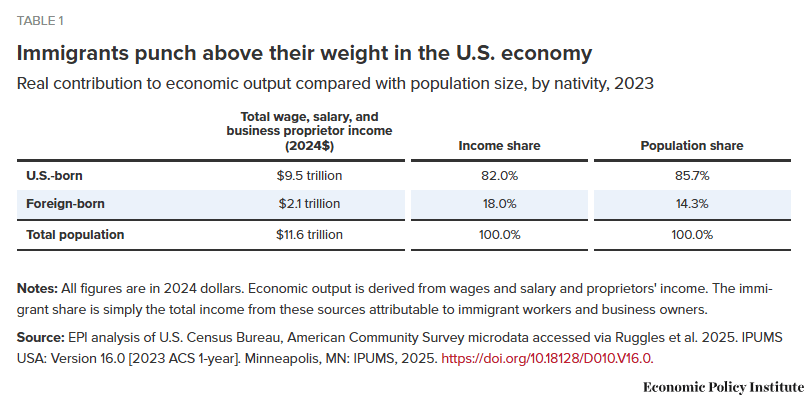
One way to quantify the contribution of immigrants to the U.S. economy is by accounting for the wages and salaries they earn, as well as the income of immigrant-owned businesses, as a share of all wages, salaries, and business income during a given period. For the United States as a whole, immigrants’ share of total output was 18.0% in 2023 (see Table 1) or $2.1 trillion in 2024 dollars. This means that the contribution of immigrants to economic output is larger than their share of the total population, as immigrants made up 14.3% of the total U.S. population in the same year.
Table 1
Immigrants punch above their weight in the U.S. economyReal contribution to economic output compared with population size, by nativity, 2023
Notes: All figures are in 2024 dollars. Economic output is derived from wages and salary and proprietors’ income. The immigrant share is simply the total income from these sources attributable to immigrant workers and business owners.
Source: EPI analysis of U.S. Census Bureau, American Community Survey microdata accessed via Ruggles et al. 2025. IPUMS USA: Version 16.0 [2023 ACS 1-year]. Minneapolis, MN: IPUMS, 2025. https://doi.org/10.18128/D010.V16.0.
Immigrants have an outsized role in U.S. economic output because they are disproportionately likely to be working and are concentrated among prime working ages. Despite accounting for 14.3% of the population, immigrants made up 18.6% of the labor force in 2023.9 Immigrants are also more likely to start businesses. Relative to their share of the population and to native-born peers, immigrants are significantly more likely to start companies of all sizes, including those that generate employment.10 Between 2005 and 2010, by one measure, immigrants had an 80% higher rate of firm founding than their U.S.-born peers.11 Even if many of these business openings ultimately result in closings, the constant churn is important to economic growth. According to another study, immigrants in 2013 accounted for 16% of the U.S. labor force but were 18% of business owners, and 28% of main street businesses, which are defined by the authors as retail, food services and accommodation, and neighborhood services such as nail salons, beauty shops, and gas stations).12
Notes
9. EPI analysis of Bureau of Labor Statistics’ Current Population Survey public data series, Table A-7: Employment Status of the Civilian Population by Nativity and Sex, Not Seasonally Adjusted. Retrieved March 10, 2025.
10. Pierre Azoulay, Benjamin F. Jones, J. Daniel Kim, and Javier Miranda, “Immigration and Entrepreneurship in the United States,” American Economic Review: Insights 4, no. 1 (March 2022): 71–88.
11. Pierre Azoulay, Benjamin F. Jones, J. Daniel Kim, and Javier Miranda, “Immigration and Entrepreneurship in the United States,” American Economic Review: Insights 4, no. 1 (March 2022): 71–88.
12. David Dyssegaard Kallick, Bringing Vitality to Main Street: How Immigrant Small Businesses Help Local Economies Grow, Fiscal Policy Institute and Americas Society/Council of The Americas, January 2015.
Published by Economic Policy Institute

 AFRICAN CENTER FOR EXCELLENCE